
The fields that make up this area are inseparable from the traditional Subak irrigation system – a traditional method preserved for centuries and passed down through generations. Here is local wisdom at its best. Indeed, Bali is blessed with 150 rivers and streams that provide water year round to irrigate this most important staple. Nonetheless, irrigation rice fields would not be successful unless man also has a hand in it.Uniquely, Bali’s complex irrigation system has its roots not by order of kings, but its management is very much in the hands of the villagers through village cooperatives. Since farmers depend on the successful irrigation of the fields, the different Subaks form an inseparable bond that unites into a single system.
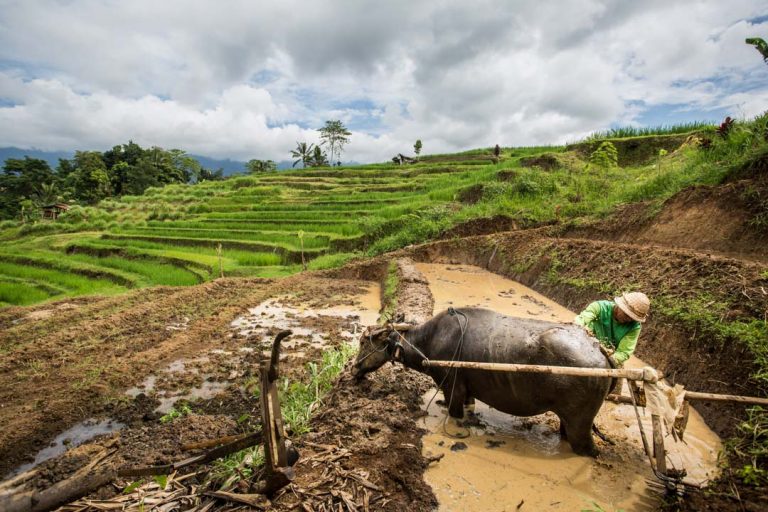
At the lowest level, each farmer is a member of a subak, whose rice fields are fed from a single dam. The head of the Subak, called the Klian Subak is elected by its members. In the larger Subak that are fed by a canal, the lowest level is called the tempek. The Subaks, in turn are linked to mountain temples or Pura Masceti, which come under the sway of one of two lake temples, these are the Pura Batu Kau which coordinates irrigation in West Bali, and Pura Ulun Danu on Lake Beratan, which coordinates the north, east and south of Bali.
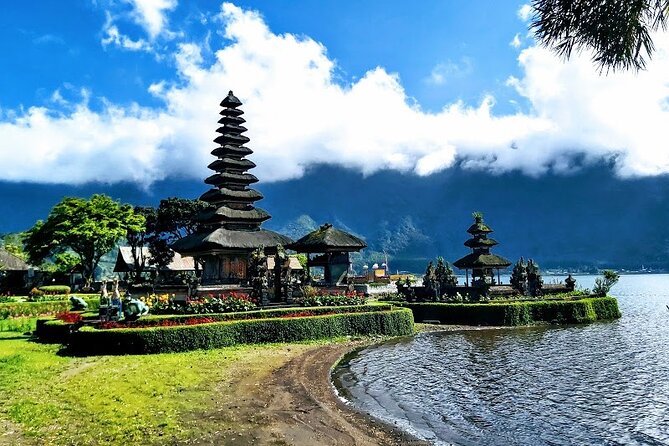
Water temples hold festivals every 105 days, corresponding with the 105 days rice-growing season in Bali. This cycle also determines the time of opening and closing of canal sluices, ensuring that plantings are staggered and that water is allocated in the most efficient and equitable manner.The goddess of Rice is known as Bhatari or Dewi Sri, the mother of Rice. As the Indonesian archipelago’s staple food, Dewi Sri is not only venerated in Bali, but also on Java and other rice-producing islands.
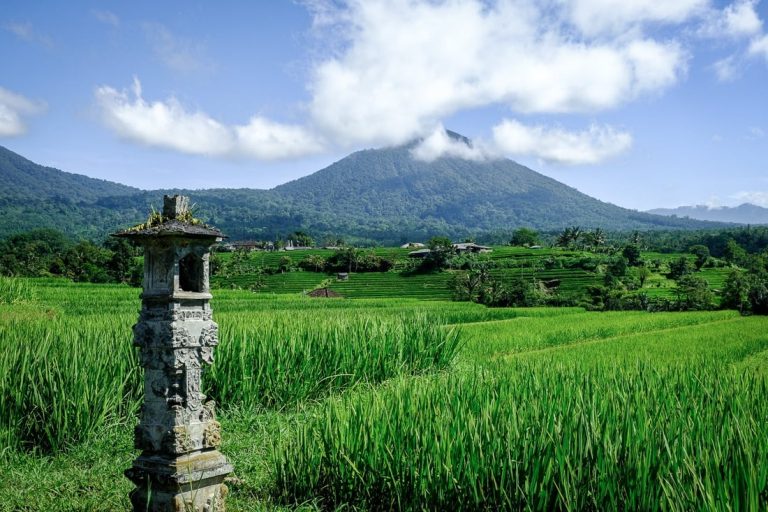
By combining sacred traditional values with a highly organized system, therefore, the Subak, the unique Balinese rice farming culture isa manifestation of the Balinese Tri Hita Karana cosmological doctrine. It is the tangible reflection of the original Balinese ideas and beliefs that are essentially rooted in this concept, namely the awareness that human beings need to always maintain harmonious relationships between Man and God, Man and fellow humans, and between Man and Nature in one’s daily life. Such a particular concept is in fact evident in the Balinese creative genius and unique cultural traditions resulting from the long human interaction, especially between the Balinese and the Hindu culture.
Whether for agriculture, nature or heritage, Jatiluwih and other rice fields in Bali remain important sites that should be preserved and must remain sustainable for future generations.
Source : Jatiluwih – Indonesia Travel